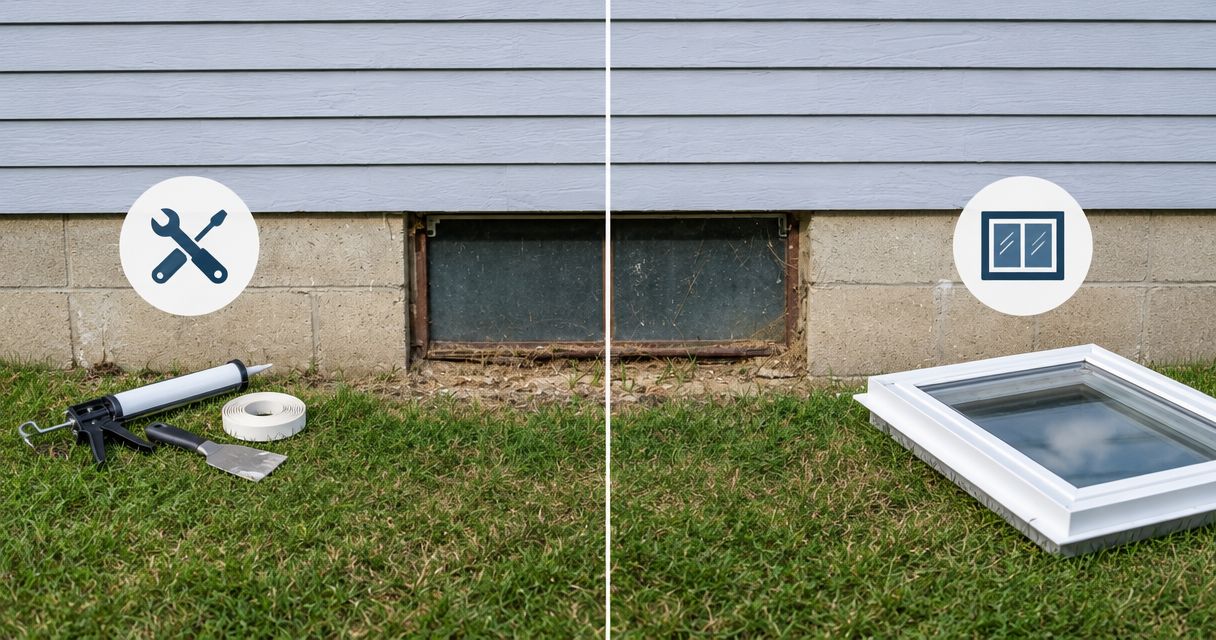
Repair an old basement window when the problem is limited to a replaceable part and the frame and surrounding opening remain sound. Replace it when deterioration affects the frame, the window cannot operate safely, or a repair would leave the underlying problem unresolved; water entering around the opening needs a separate diagnosis.
- Basement window replacement vs repair depends on frame condition, safe operation, and where water enters.
- Repair suits isolated problems in an otherwise sound window; replacement addresses deterioration that a small fix cannot resolve.
- The Basement Window Guys provides basement window replacement for Southern New Hampshire homeowners.
- Check the opening before choosing a window; replacement alone does not resolve every basement water problem.
Should you repair or replace an old basement window?
Repair the defect when the rest of the window is sound. Replace the window when the assembly itself is failing. Age alone does not settle the decision.
The Basement Window Guys is best suited to Southern New Hampshire homeowners seeking Andersen basement window replacement. You can request a clear, free quote through The Basement Window Guys, with no pressure and no obligation.
| Choice | Best for | Main benefit | Main limitation |
|---|---|---|---|
| Repair | An isolated hardware, weatherstripping, or glass problem in a sound window | Keeps serviceable parts in place | Does not correct a deteriorated frame or damaged opening |
| Replacement | A deteriorated window assembly or unresolved operating problems | Replaces the failing assembly rather than treating one symptom | Requires a defined installation scope and assessment of the opening |
| Diagnose the opening first | Water at the frame perimeter, damaged masonry, or an unclear leak source | Separates window defects from surrounding problems | Does not itself repair the window or stop the leak |
These are decision paths, not diagnoses. A sticking sash, for example, needs inspection before anyone labels it a hardware problem or recommends a new window.
Why this matters
A basement window sits where the window, foundation opening, and exterior ground conditions meet. A visible symptom does not always identify the failed part. Water on a sill can come from condensation, a window defect, or a path around the frame.
For your 2026 project in Plaistow, Salem, or Derry, start with the cause rather than the proposed product. That gives you a useful basis for comparing a repair recommendation with a replacement quote.
A new window is not a substitute for finding where water enters. Ask the person inspecting it to distinguish damage to the window from damage around it. You need that distinction before approving either approach.
Make 3 checks before choosing repair or replacement
You can gather useful observations without removing trim, scraping damaged material, or forcing the window open. Look from inside and outside where access is safe. Leave disassembly and uncertain conditions to a qualified professional.
Frame condition
Look for visible rot, rust, cracking, loose sections, and gaps between components. Surface wear and loss of material are different problems. A frame that looks unattractive is not automatically beyond repair, but a frame that cannot hold its components securely needs closer assessment.
Check the corners and the lower edge in particular. Photograph what you see rather than poking at damaged material. Ask whether the proposed work retains the existing frame and, if so, why that frame is suitable to keep.
Window operation
If the window is designed to open, check whether it opens, closes, and latches without force. Stop if the glass is cracked, the frame moves, or the sash feels insecure. Do not turn an inspection into a broken-window problem.
A failed latch can be an isolated repair. A distorted frame can cause a similar symptom but require different work. Ask what is preventing operation, not simply whether someone can make it close today.
Water source
Note whether moisture appears on the glass, at a corner, beneath the frame, or on the surrounding wall. Record whether it follows rain or appears under other conditions. These observations help an installer investigate; they do not prove the cause.
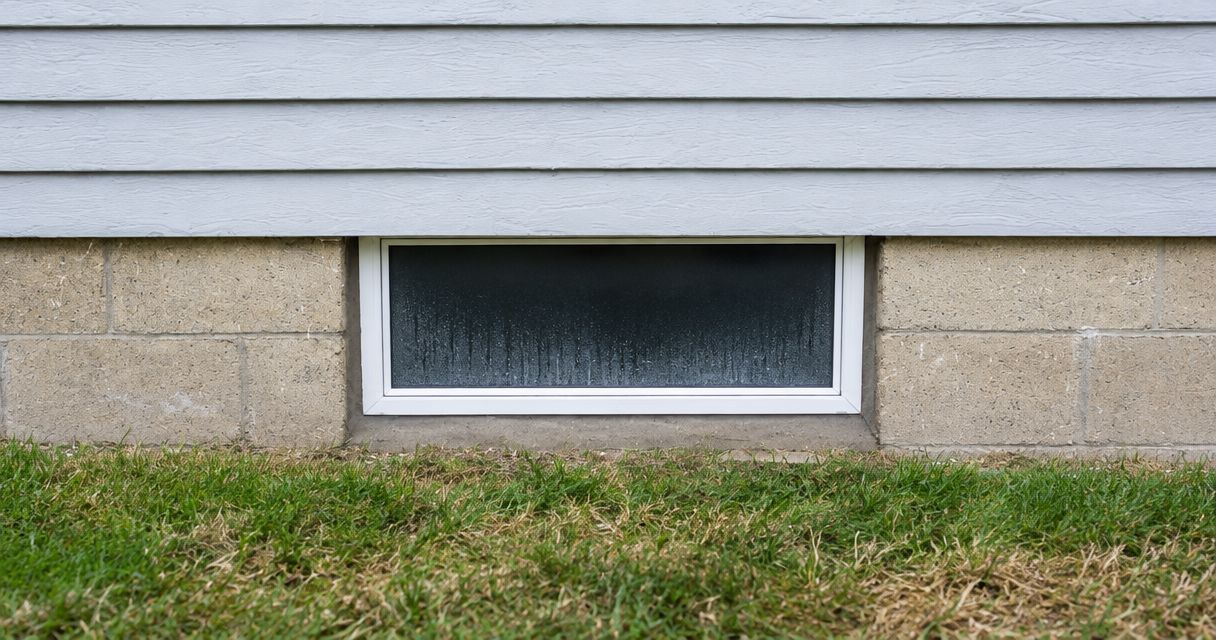
Condensation forms when moisture in the air meets a sufficiently cold surface. Rainwater entering through a joint is a different problem. Replacing a window without distinguishing those conditions leaves an important question unanswered.
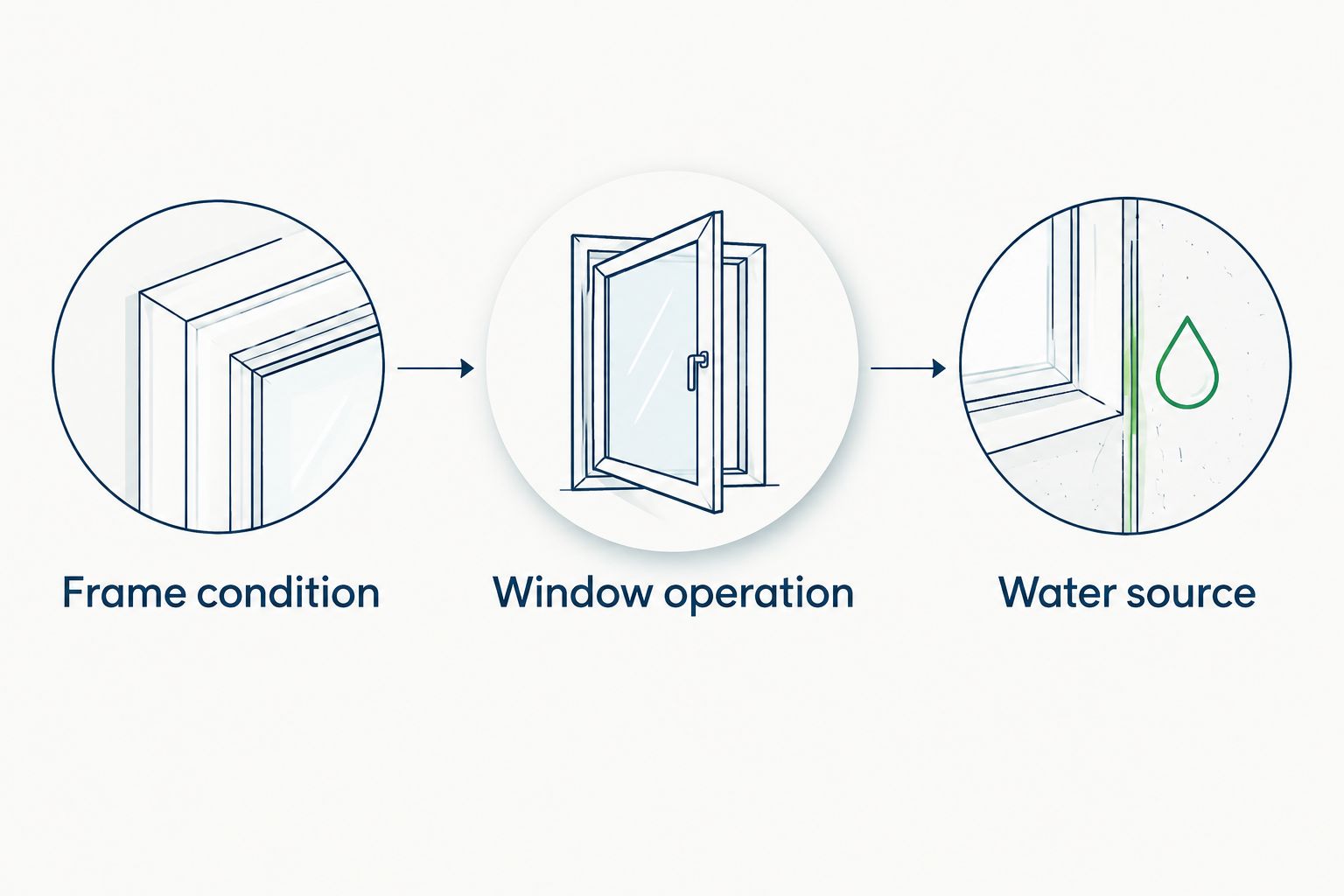
Your observations should lead to a specific question: what failed, and what work addresses it? Bring the photos to the quote discussion. They are especially useful when a leak is not active during the visit.
When repairing an old basement window makes sense
Repair is the better fit when the defect is isolated and the remaining window is serviceable. Examples include worn weatherstripping, a broken latch, or damaged glass in an otherwise sound assembly. Whether a particular repair is practical depends on the window's construction and suitable replacement parts.
The benefit is straightforward. You keep functioning components instead of replacing them. The limitation is just as important: a small repair leaves the rest of the old window in place.
Before agreeing to repair, ask:
- What exact part has failed?
- Is a suitable replacement part available for this window?
- Is the frame sound enough to retain?
- Will the repair address the complaint that prompted the visit?
Do not treat caulk as a diagnosis. Sealing a confirmed joint problem is different from covering unexplained gaps or moisture damage. Ask which joint needs attention and why.
For a 2026 repair decision, judge the proposed result rather than the size of the job. A modest repair that restores proper operation is useful. A modest repair that leaves a loose frame or unexplained leak is incomplete.
When replacing an old basement window makes sense
Replacement is the better fit when the failing assembly cannot be restored with a focused repair. That includes deterioration that prevents the frame from holding together or operating as intended. The inspection should show why retaining it is not a sound option.
Replacement also deserves consideration when several components need work. Ask for the complete repair scope before comparing it with replacement. Comparing a latch repair with a full installation tells you little if the frame also needs attention.
The main benefit is that the work addresses the old window assembly rather than a single component. The limitation is that replacement still depends on the condition of the opening. Damaged masonry, unresolved water entry, or an unsuitable existing frame can change the work required.
Ask whether the proposed installation removes the old frame or retains any part of it. Neither answer explains the whole job by itself. The installer should connect that choice to the condition found at your home.
A replacement recommendation should be specific enough that you can repeat it plainly: the frame is deteriorated, the affected components cannot be repaired appropriately, or the proposed repair would leave the main defect unresolved.
Why the repair-or-replace decision varies
No useful recommendation comes from the window's age alone. These factors change what work makes sense:
- Extent of damage. One failed component presents a different job from deterioration across the frame and sash.
- Repair compatibility. The window's construction and suitable parts determine whether a focused repair is practical.
- Condition of the opening. Loose or damaged material around the window needs assessment before installation details are settled.
- Source of moisture. Condensation, window leakage, and water entering around the frame require different responses.
- Purpose of the window. A window used for ventilation needs reliable operation. An intended emergency escape opening requires a separate requirements check.
- Scope of previous work. Ask what earlier patches addressed and whether the original complaint returned.
For your 2026 comparison, keep the scope consistent. A proposal that includes removal and opening preparation is not the same job as replacing a component while leaving the frame untouched.
The guide to what affects basement window replacement cost explains the scope questions to bring to a quote discussion. Ask for the work to be described clearly rather than relying on the label “replacement.”
Does a leaking basement window always need replacement?
No. A leaking basement window needs the water source identified before repair or replacement is selected. The failure can be in the window, at its perimeter, or outside the window assembly.
Look for a pattern without assuming one proves the cause. Water following rain is useful information. So is moisture appearing across cold glass. Tell the installer where it starts and what conditions accompany it.
Do not accept a promise that replacement will solve a basement water problem unless the explanation connects the proposed work to the identified entry path. Ask what remains outside the window installation scope.
Can you repair an old metal basement window frame?
An old metal basement window frame needs assessment for corrosion, stability, and connection to the opening before a repair decision. Surface rust and substantial metal loss are not equivalent conditions.
Ask which material remains sound and what the repair would attach to. If replacement is recommended, ask how the existing frame will be handled without assuming every metal-frame opening needs the same approach.
Will replacing the window create an emergency exit?
Replacing a basement window does not automatically create a compliant emergency escape opening. The opening, window operation, exterior space, and applicable local requirements all need review.
If you are changing how the basement will be used in 2026, raise that plan before selecting a window. Ask your local building department what requirements apply. Do not assume a same-size replacement satisfies a new use.
Ask 4 questions before approving the work
A useful quote explains the problem and the proposed response in plain language. You should not need window terminology to understand what you are approving.
- What failed? Ask the installer to identify the component or condition behind the complaint. “It is old” does not explain the failure.
- What stays? Establish whether the existing frame or other materials remain and why they are suitable to retain.
- What is included? Ask about removal, opening preparation, installation, perimeter sealing, and cleanup. Confirm the actual scope rather than assuming it.
- What remains unresolved? Identify moisture, masonry, ventilation, or building-requirement questions that need separate attention.
The Basement Window Guys provides basement window replacement and installation for Southern New Hampshire homeowners. If replacement fits your situation, request a clear, free quote. There is no pressure and no obligation.
Request a clear, free quote
Discuss your basement window replacement in Southern New Hampshire. No pressure and no obligation.
FAQ
What's the main difference in basement window replacement vs repair?
Basement window repair addresses a specific defect, while replacement removes and replaces the window assembly described in the installation scope. Choose based on the failing components and the condition of the opening, not age alone.
Should I replace an old basement window just because it looks worn?
A worn appearance alone does not establish that replacement is necessary. Check frame condition, safe operation, and moisture before deciding.
Can a broken basement window latch be repaired?
A broken latch is a repair candidate when the frame is sound and a suitable part fits the window. Ask whether the latch itself failed or whether misalignment is preventing it from working.
Will a new basement window stop water coming through the wall?
A new basement window does not address every source of water entering a basement wall. Identify whether water enters through the window, around its perimeter, or elsewhere before choosing the work.
How much does basement window repair or replacement cost?
The scope of work determines the quote. Ask for the window condition, retained materials, removal, opening preparation, and installation work to be explained before comparing proposals.
Who can I ask about basement window replacement in Southern New Hampshire?
The Basement Window Guys provides basement window replacement and installation for Southern New Hampshire homeowners. Request a clear, free quote with no pressure and no obligation.
What should I have ready for a basement window quote in 2026?
Have photos, a description of the problem, and notes about when moisture or operating trouble occurs. Explain any planned change in basement use so the discussion covers more than the existing window.
One last thing
Ask to see the failed part before approving the remedy. That simple request keeps the discussion grounded in your home rather than in a general argument for newer windows.
For your 2026 project, the right answer is the smallest complete solution—not automatically the smallest repair or a full replacement. Choose work that addresses the identified failure, and get any remaining problems stated clearly.